
What Actually is Driving Markets: G.L.R.
In the intricate world of global macro investing, understanding the driving forces behind market movements is crucial. If you tune into the news, you will hear any one of a hundred reasons as to why the market is up or down. There is no shortage of talking heads talking their book and making bold prognostications about where the S&P will end up at year end or what the Fed is going to do next month. But the reality is this is all just noise, and it is devoid of action-useful insights. This is where we step in.
At MacroAware.ai, we believe markets are driven by surprises in one of three things: a surprise in Growth (G), a shift in macro Liquidity (L), or a shock to Risk Appetite (R). This is the core of our G.L.R. framework and it offers a systematic approach to dissecting the forces moving markets, providing clarity and actionable insights for investors. By focusing on these three macro factors, the G.L.R. framework simplifies the complexity of markets, helping us to identify key turning points and make informed decisions.
Table of Contents
Exploring the G.L.R. Components:
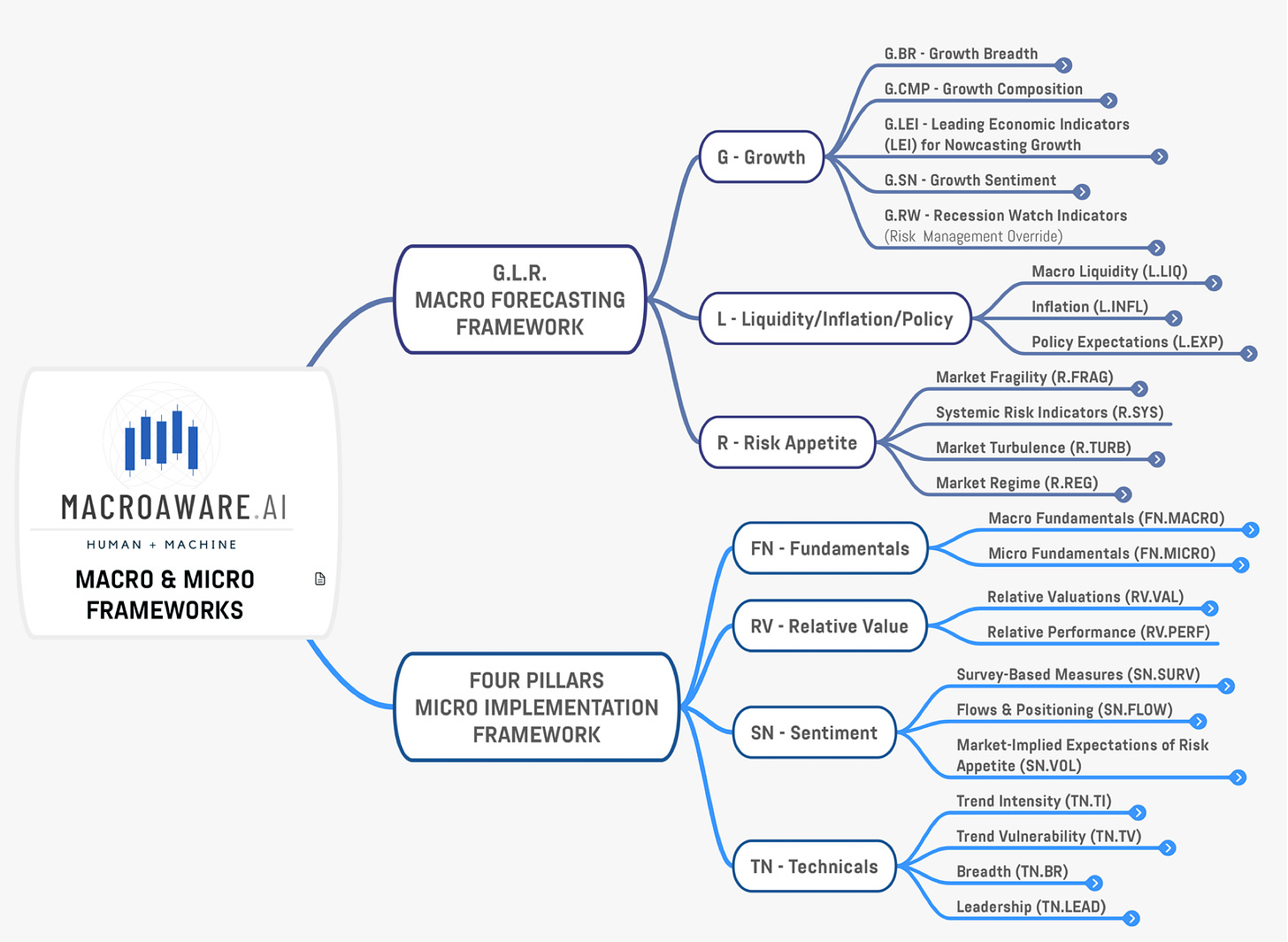
Growth (G) - Growth indicators assess economic activity and its potential to create wealth.
Not all data is created equal. Most conversations around “growth” tend to revolve around backward-looking measures of activity, such as GDP or PMIs (which are coincident at best). This is one of the reasons why turning points often go unnoticed and are missed until it’s too late.
At MacroAware.ai, we are not in the business of trying to forecast GDP or levels of unemployment. Rather, we are market practitioners striving to anticipate market behavior and forecast subsequent trends across and within asset classes.
Therefore, we instead focus on data that is leading or anticipatory for markets. To do this, we supplement traditional measures of economic activity with forward-looking models and signals, such as from leading economic indicators (LEIs) and nowcasting models, to predict turning points in the business and market cycles.
We also have to put this in the context of Growth Sentiment, which is used to gauge where we are in the state of Growth relative to expectations. For example, if LEIs are suggesting a rollover in economic activity, but market expectations are already largely expecting an imminent recession, then we might actually want to do the opposite (or do nothing - alpha preservation can be just as important as alpha generation).
Liquidity (L): Liquidity examines the availability of money, credit, and capital in the economy.
Liquidity in excess of what the real economy is able to absorb is a key focus for us, as it tends to influence asset prices and market behaviors.
There is often a feedback loop between Liquidity and Growth (and ultimately the next pillar, Risk Appetite). Understanding liquidity dynamics helps anticipate market responses to monetary policies and capital flows.
Risk Appetite (R): Risk appetite gauges the willingness of investors to hold risky assets.
In this part of the framework, we seek to understand whether investors are risk-seeking or risk-averse, and whether their level of Risk Appetite is potentially at an extreme, either in fear or euphoria.
Indicators such as volatility measures, sentiment indices, and market positioning provide insights into market stability and potential shifts in risk tolerance.
In addition, It is essential to be able to gauge whether or not and where we are being adequately compensated for taking risk.
Implementing the G.L.R. Framework:
The G.L.R. framework is applied through a structured process involving signal generation, insight capture, risk management, and system enhancement. By integrating both top-down macro analysis and bottom-up market perspectives, the framework provides a comprehensive view of market conditions.
Consider an investment scenario during a period of economic uncertainty. The G.L.R. framework helps identify a potential turning point in growth, driven by leading indicators and sentiment analysis. Simultaneously, liquidity measures reveal tightening conditions, and risk appetite indicators suggest heightened market fragility. By synthesizing these insights, we can mitigate potential losses during the volatile period by adjusting the portfolio to reduce exposure to high-risk assets and adopt a more defensive relative value posture (e.g., increasing allocation to the Quality factor from Value, investing in more defensive safe-haven currencies and segments of global yield curves, favoring carry and convexity), .
Challenges and Best Practices:
While the G.L.R. framework offers valuable insights, its effectiveness depends on the quality and timeliness of data. Regular updates and continuous learning are essential to maintain the accuracy of predictions. Additionally, integrating codified human judgment with the systematic approach of G.L.R. ensures well-rounded decision-making.
Why G.L.R. Matters
The G.L.R. framework provides a robust foundation for navigating global macro markets. By focusing on growth, liquidity, and risk appetite, investors can simplify complex market dynamics and make more informed decisions. Embracing this systematic approach enhances the ability to identify key turning points and optimize investment strategies.
Join our complementary newsletter and let us help you navigate uncertainty by cutting through the noise.